














BFCM Best Practices for Loyalty Systems in 2026
Record sales, record discounts, one-time customers. Run BFCM 2026 as an enrollment event instead.
CHAPTER 1
The 2025 scoreboard said one thing. The margin line said another.
Cyber Week 2025 closed at $44.2 billion in U.S. online spend, up 7.7% over 2024. Black Friday alone did $11.8 billion, up 9.1%. Shopify merchants moved $14.6 billion across the weekend, a 27% jump, with 81 million shoppers and an average order value of $114.70. By the headline numbers, the weekend worked.
Look one line down and the picture changes. Electronics sold at 30.9% off. Toys went at 29.6%. Apparel moved at 25.1%. Brands bought that 7.7% growth with the deepest discounting on record, then watched most of those buyers leave. The revenue arrived. The customer did not stay.
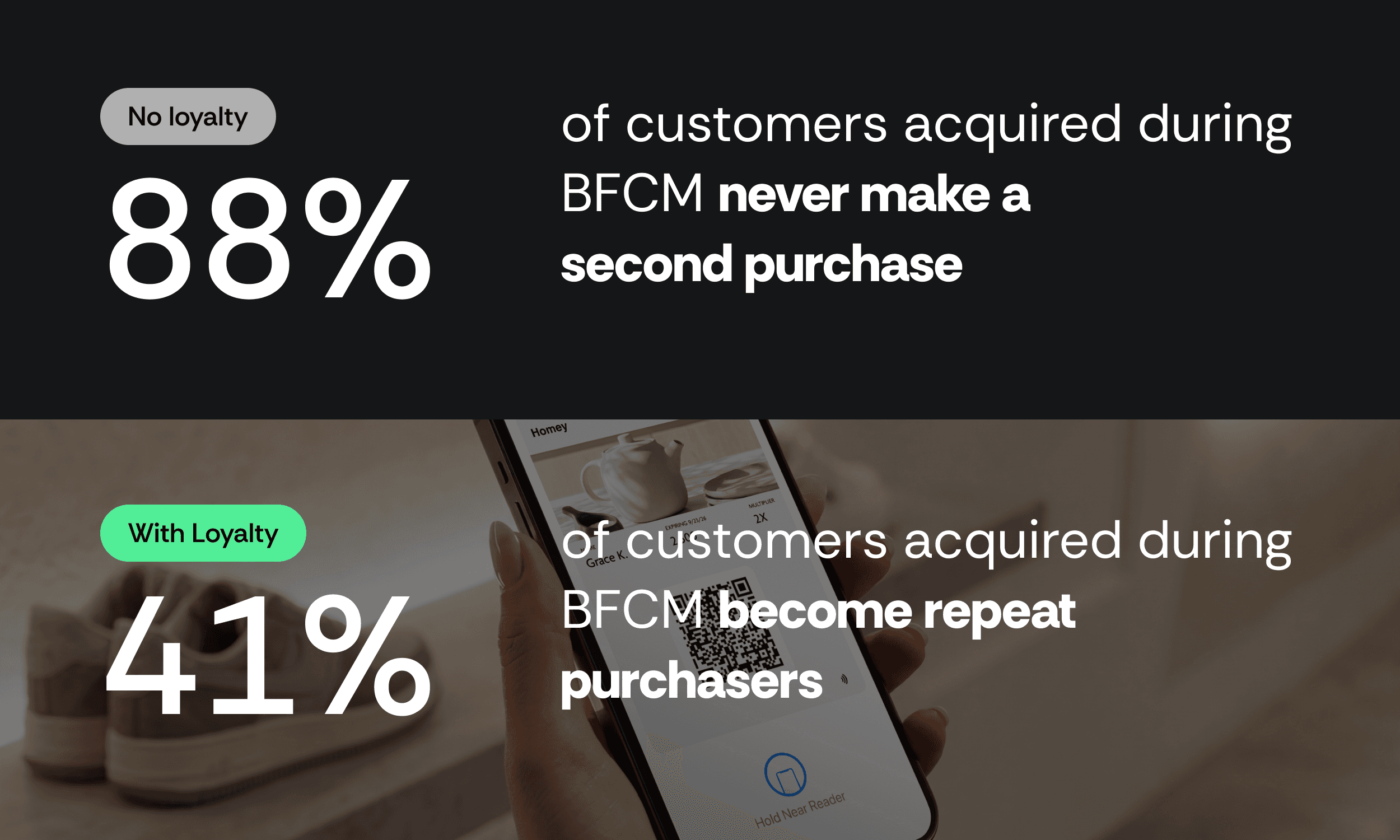
The subscription numbers tell the same story in sharper form. Of the customers who start a subscription during BFCM, 88% have cancelled by February. Brands spend the weekend buying signups that are gone before Valentine's Day.
Discounting harder will not fix this. A different operating model will.
Make the shift before November: stop treating BFCM as an acquisition event and start running it as an enrollment event. The question is not how much you sell on November 27. The question is how many of those buyers you can identify, enroll, and bring back before December 25.
CHAPTER 2
Why loyalty systems are the 2026 margin lever
A 25% sitewide discount takes a quarter off every order, from every shopper who shows up, whether or not they come back. At Shopify's BFCM average order value of $114.70, you hand roughly $29 to a stranger with nothing attached to it. You cannot target it, you cannot claw it back, and you cannot make it conditional on a second purchase.
A loyalty system spends the same margin on purpose. You decide who earns 3x points and who earns 2x. You decide which collections earn at all. You decide which tier opens the early-access window, and you change any of it at the SKU level, in the hour, without an engineering ticket.
Discounts buy a transaction. A loyalty system buys the next four.
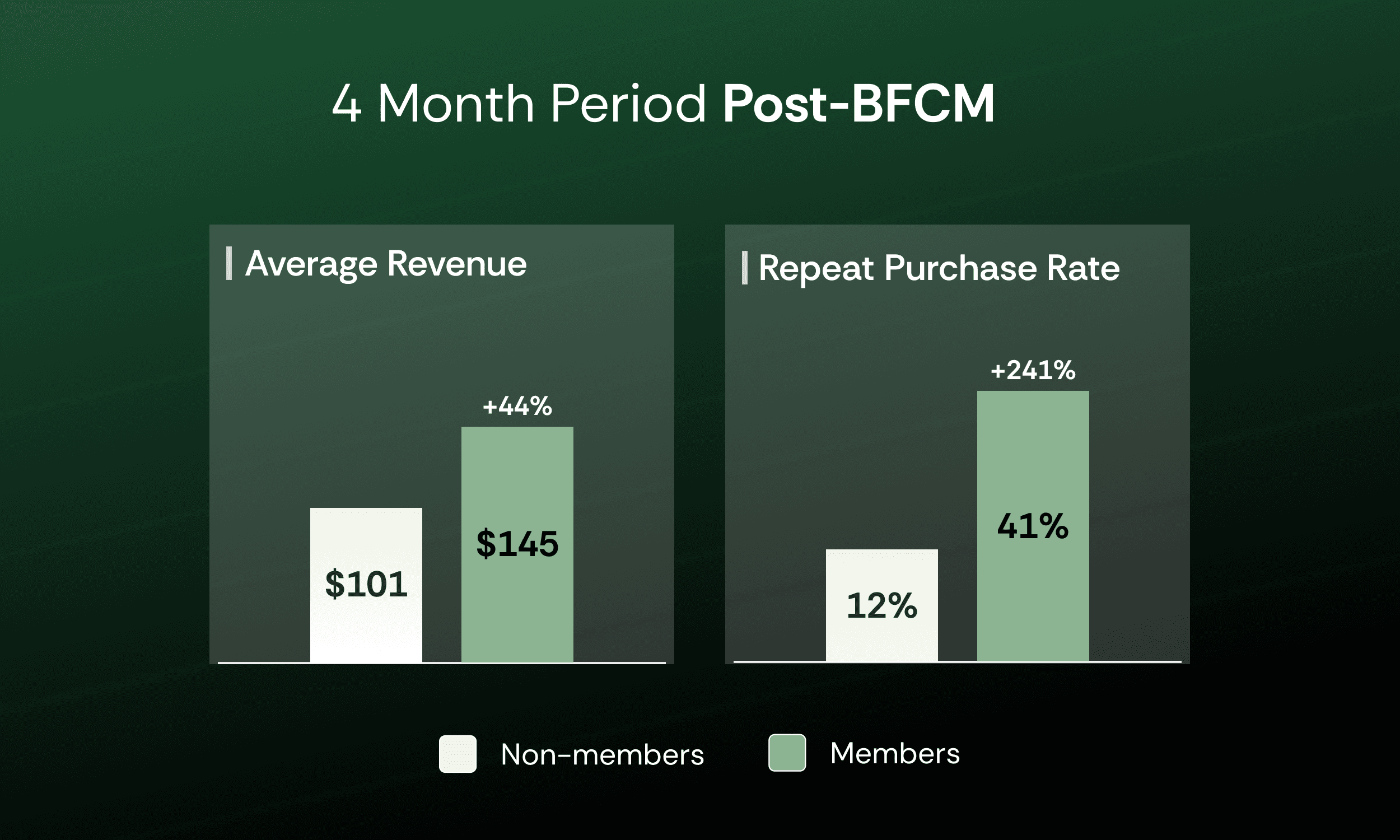
Our BFCM 2025 cohort, drawn from the 600+ brands running on Bubblehouse, shows the gap. Within 6 months, members spent 44% more than non-members, $145 against $101. They repurchased at 3.4x the rate compared to non-members. And daily enrollment during Cyber Week ran at five times the October pace, because the shoppers you pay the most to acquire are also the ones most ready to join.
CHAPTER 3
Five things that changed since last BFCM
The discount floor dropped, and it is not coming back up. Shoppers arrive in late November expecting 25% to 30% off in most categories. A brand holding at 15% loses the click. The lever you still control is what happens after the order.
AI now sits between you and the shopper. Adobe recorded a 693.4% increase in AI-referred traffic across the 2025 season, and a 670% jump on Cyber Monday. Shoppers ask an assistant to compare instead of browsing a category page. When the AI runs the comparison, price wins, unless the shopper carries a reason to prefer you. Membership, points balance, and tier status are that reason.
The wallet replaced the app. Juniper Research puts digital wallet users at 4.3 billion in 2026, roughly 53% of the world. Among U.S. 18-to-26-year-olds, 91% use a digital wallet as their primary payment method. Nobody downloads a loyalty app for Black Friday. Everybody arrives at checkout with Apple Wallet already open.
Retail and ecommerce stopped being separate budgets. Shopify saw cross-border orders reach 16% of volume, and merchants ran the weekend across POS, marketplace, and web at once. A member who earns points in-store on Friday and redeems online on Monday needs one balance, not two systems.
The calendar gives you room this year. Thanksgiving lands on November 26, 2026. Black Friday is November 27, Small Business Saturday is November 28, and Cyber Monday falls on November 30. Cyber Week closes before December starts, leaving the entire month clear for a second purchase. In 2025 Cyber Monday spilled into December 1 and compressed that runway. Plan the December reactivation now, because you have more of it than you did last year.
CHAPTER 4
Loyalty programs versus loyalty systems
A loyalty program is a points table. Customers earn one point per dollar, redeem at a fixed rate, and you change the rules once a year with an engineering ticket.
A loyalty system is infrastructure. It reads from your POS, your ERP, your subscription platform, and your CRM. It runs different multipliers for different tiers, different earning rules for different collections, and different rewards for different segments, all configurable by your retention team in an afternoon.
The difference matters most in the last week of November, when your merchandising plan changes twice a day and your program either keeps up or gets switched off.
Ditch loyalty programs. Build loyalty systems at scale.
CHAPTER 5
The BFCM 2026 playbook: seven plays
Play 1. Build the promotion engine before you build the promotion
Most brands decide their BFCM loyalty offer in early November, then discover their platform cannot execute it. Reverse the order. Confirm what your system can run, then design against those capabilities.
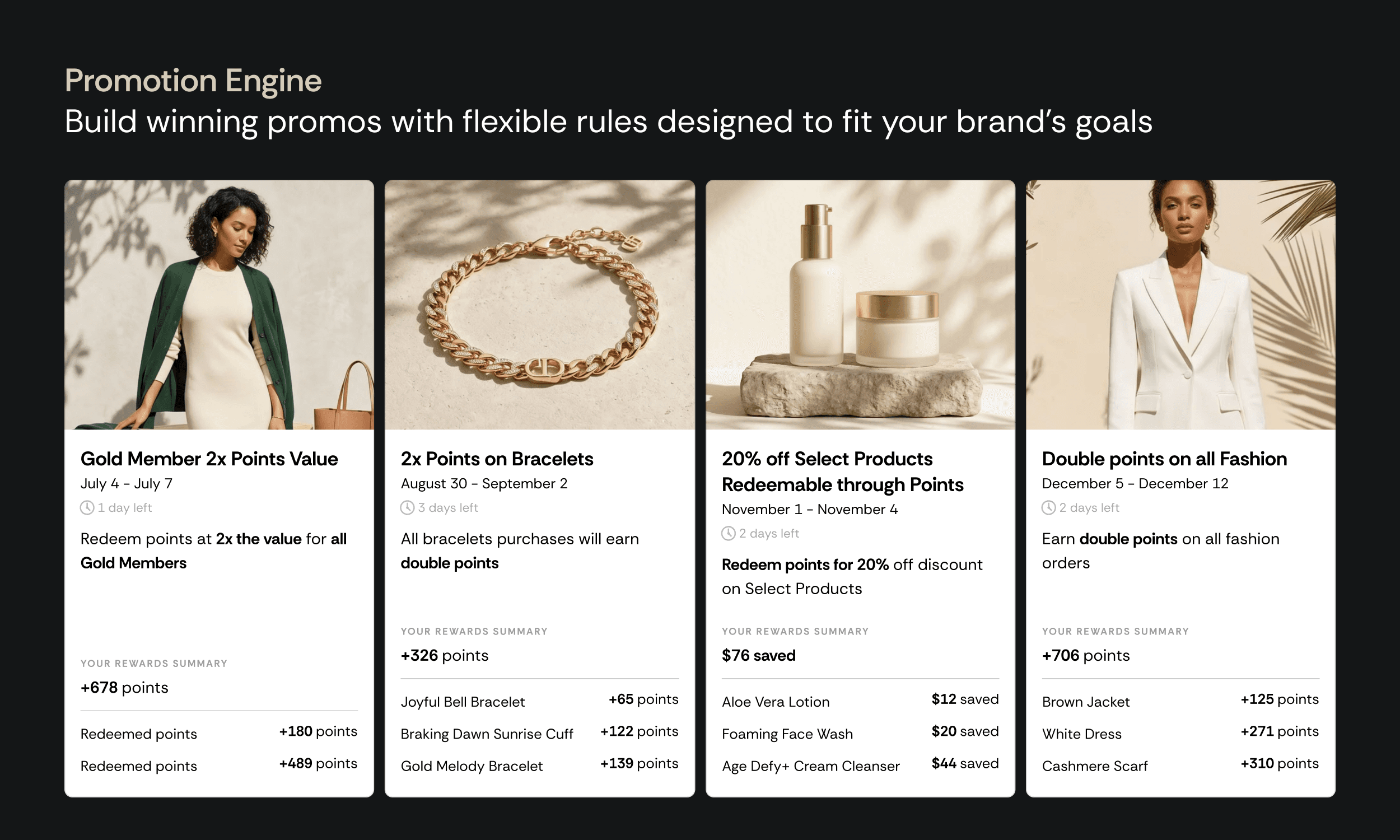
At minimum, your loyalty system should let your team run all of the following without a developer:
Double and triple points windows scheduled to the hour, so Thanksgiving evening, Black Friday morning, and Cyber Monday each carry a different earn rate
Spend X, get X thresholds that stack on top of the sitewide discount rather than competing with it
Product-level gating so points multipliers apply only to full-price collections, new arrivals, or the categories where you hold margin
Exclusions that keep clearance, gift cards, and third-party SKUs out of the earn calculation
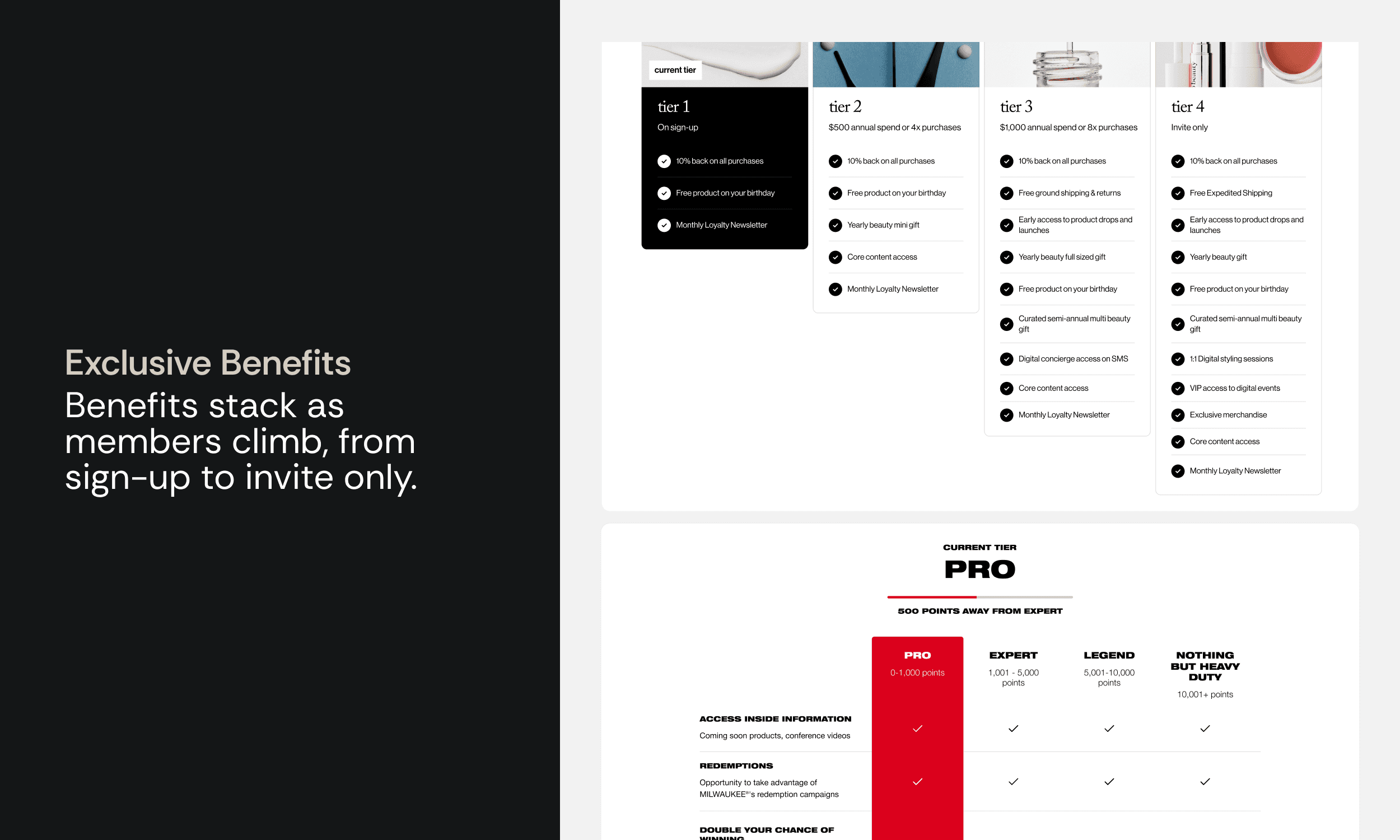
Tier-differentiated multipliers and reward values, so a Gold member earns 3x while a new member earns 2x on the same order
That last one does the heaviest lifting. A flat promotion treats your best customer and a discount-hunting stranger identically. Tier-differentiated earning tells your top 5% that their status is worth something on the busiest weekend of the year, and it gives everyone else a visible reason to climb.
One specialty retail merchant on Bubblehouse ran 3x points gated to full-price collections in place of a second sitewide markdown last November. The points liability came to 9% of member revenue against the 25% the markdown would have cost, and member conversion held within two points of the sitewide offer. Same weekend, same traffic, sixteen points of margin kept.
Play 2. Make the wallet pass your enrollment surface
Your BFCM shopper checks out on a phone. Adobe put mobile at 57.5% of Cyber Monday sales. Asking that person to create an account, verify an email, and log into a portal is asking them to do work at the worst possible moment.
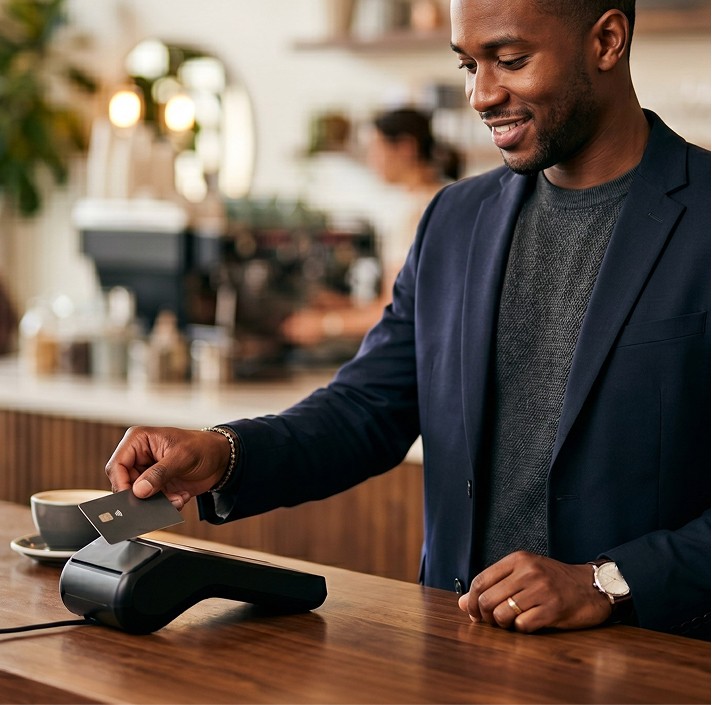
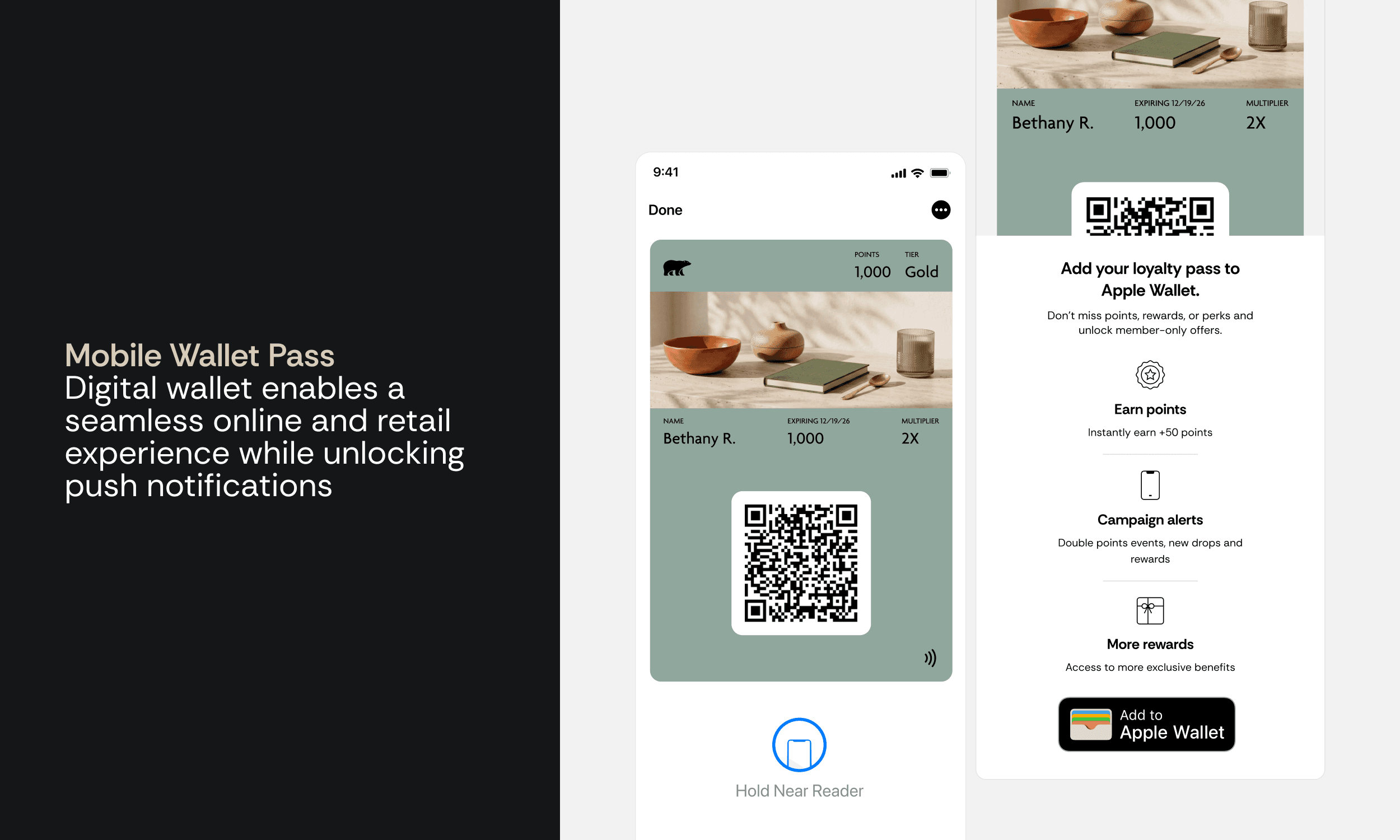
Issue a wallet pass instead. One tap at checkout puts a branded loyalty card into Apple Wallet or Google Wallet, carrying their points balance, tier, and any active challenge. From that moment you own a channel that does not depend on inbox placement or SMS deliverability:
The balance updates in real time after every transaction, online or in-store
Lock-screen notifications reach members when they pass a store
The pass scans at the register as their member ID
Tier changes update the pass artwork, so status stays visible
PYMNTS data shows digital wallet users spend 31% more than non-users. The average consumer carries 17.9 loyalty memberships. In our merchant base, members with an installed pass transacted 46% more often over the 90 days after BFCM than members without one. The pass is how you stay one of the few memberships they use.
Set this up in October. A pass that goes live on November 20 will never catch up to one that has been enrolling members since early fall.
Play 3. Run BFCM as a season of challenges, not a weekend of discounts
A discount gives someone a reason to buy once. A challenge gives them a reason to come back on Tuesday.
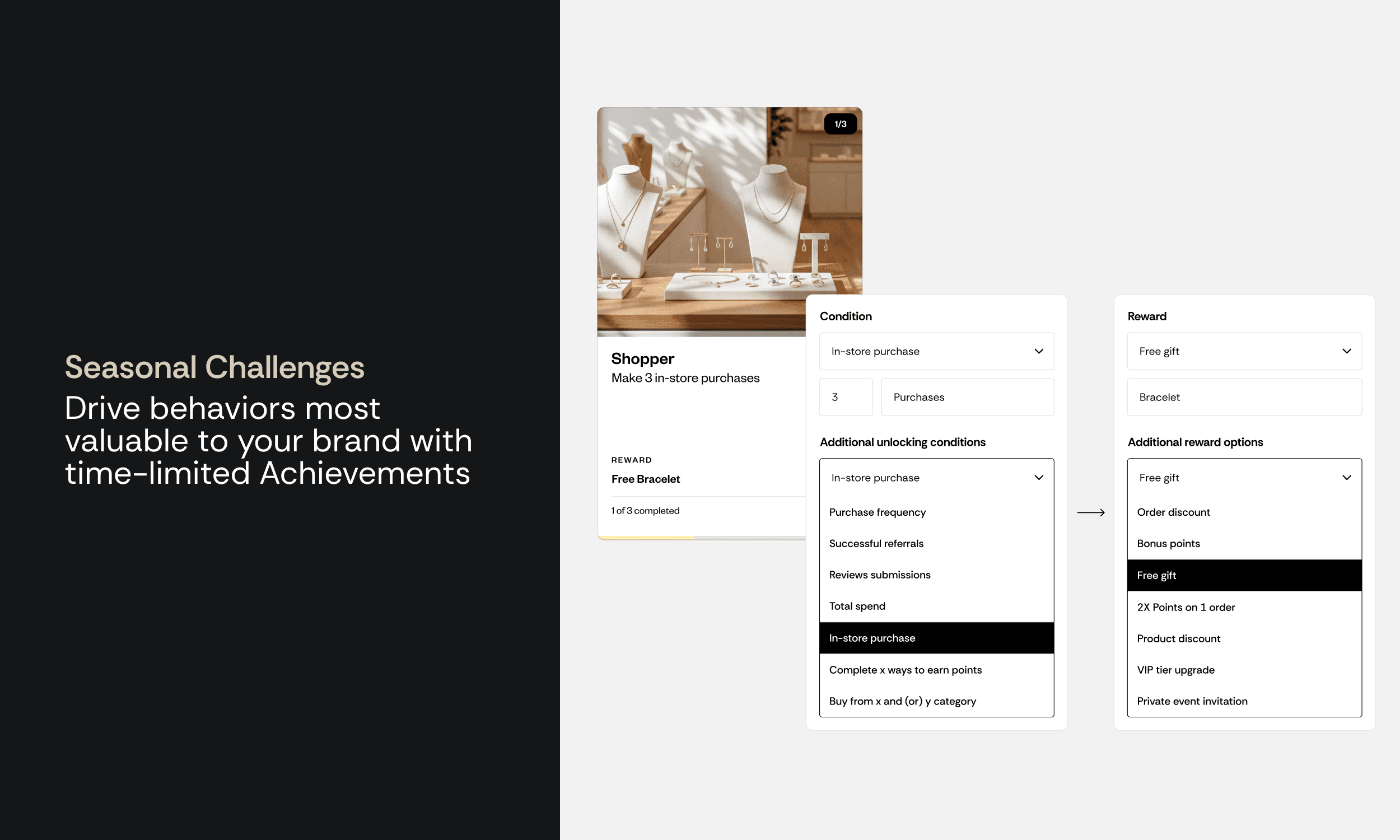
Build a time-limited achievement track that opens the week before Thanksgiving and closes December 24. Structure it so completion requires more than one visit:
Buy from two different categories to unlock a bonus reward
Complete a profile, leave a review, and refer a friend to earn a limited badge
Hit a cumulative spend threshold across the season rather than a single order
Collect a set of badges that exist only during this window and never return
Scarcity makes this work. A badge available all year is decoration. A badge available for 30 days, displayed on a member's wallet pass and account page, drives a second purchase in December that your discount never would have earned.
The numbers back the mechanic. Across merchants running seasonal tracks last year, 34% of members who started a challenge finished it, and those completers repurchased before January 31 at 3.1x the rate of members who never started one. J.Lindeberg has used time-limited achievements to turn holiday traffic into repeat engagement rather than one-time redemption.
Play 4. Give existing members something new customers cannot buy
Every brand runs its best offer for strangers during BFCM. Your most valuable customers watch the acquisition discount land in their inbox and recalculate what their loyalty is worth.
Fix that with member-exclusive mechanics that sit above the public offer:
Early access windows, 24 to 48 hours ahead of the public sale
Higher point multipliers by tier, visible on the product page before they add to cart
Reward values that scale with status, so a Platinum member's $20 reward is worth $35 to them
Member-only bundles or colorways that never appear in the public catalog
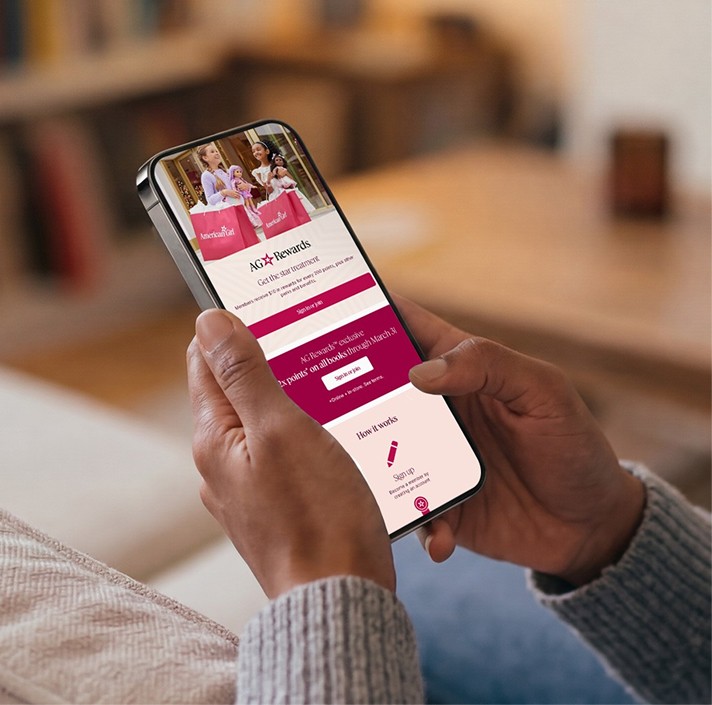
American Girl and Because Market both run versions of this pattern: the public sees a discount, the member sees a better weekend.
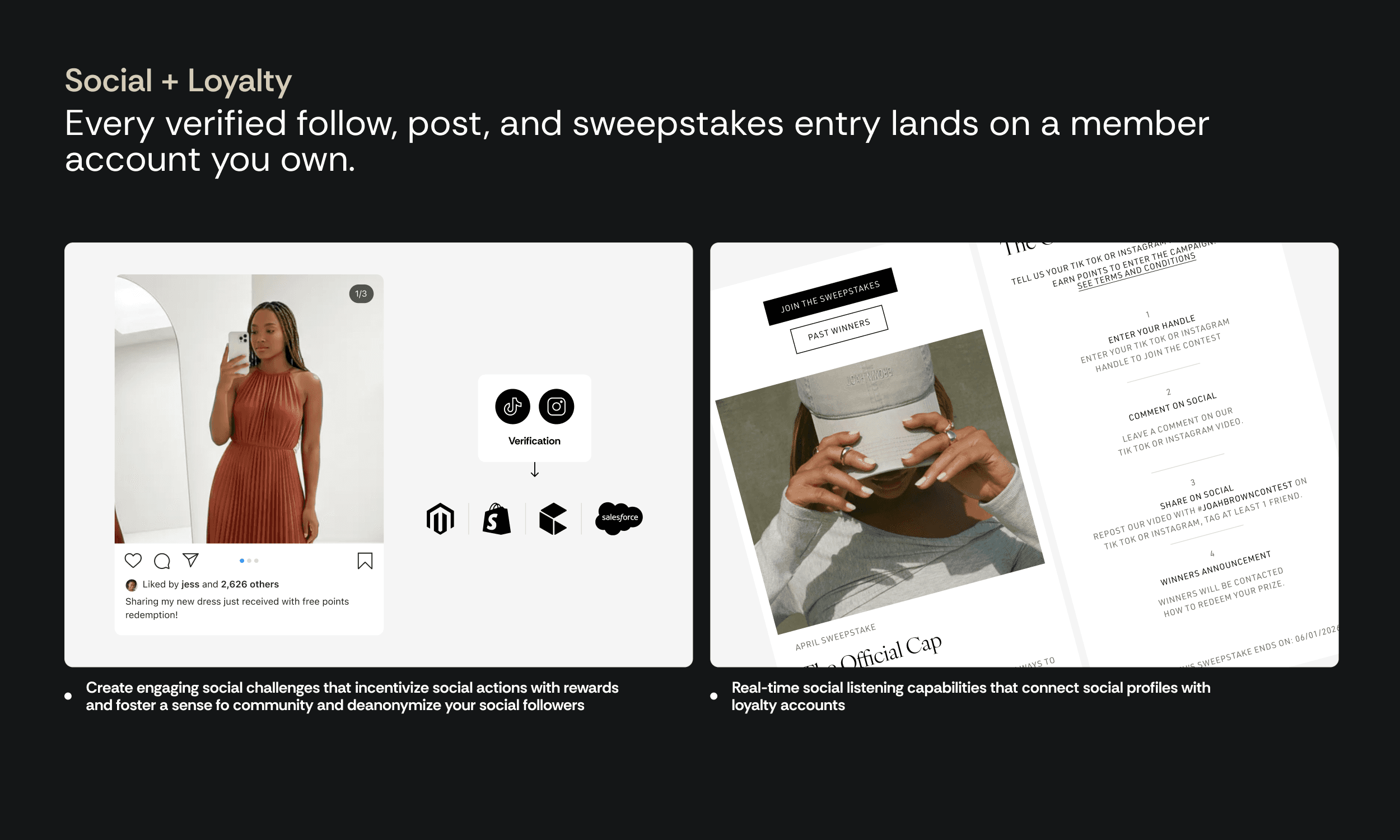
Play 5. Turn social into a tracked, rewarded channel
Social drove 4.6% of holiday season revenue in 2025, up 40.3% year over year. Most brands still measure that channel with a coupon code and a hope.
Wire social into the loyalty system directly:
Award points for verified follows, shares, and tagged posts rather than self-reported ones
Run a sweepstakes where entries are earned through loyalty actions, so every entry also produces a data point you keep
Weight entries by tier, giving members more chances as they climb
Gate a limited badge or reward behind UGC submission during the BFCM window
A sweepstakes attached to your loyalty system produces enrolled members with known purchase history. A sweepstakes run through a standalone giveaway tool produces email addresses.
Play 6. Put loyalty where the shopper already looks
None of the six plays above matter if members cannot see them. Loyalty visibility is the cheapest conversion work available in November, and most brands skip it.
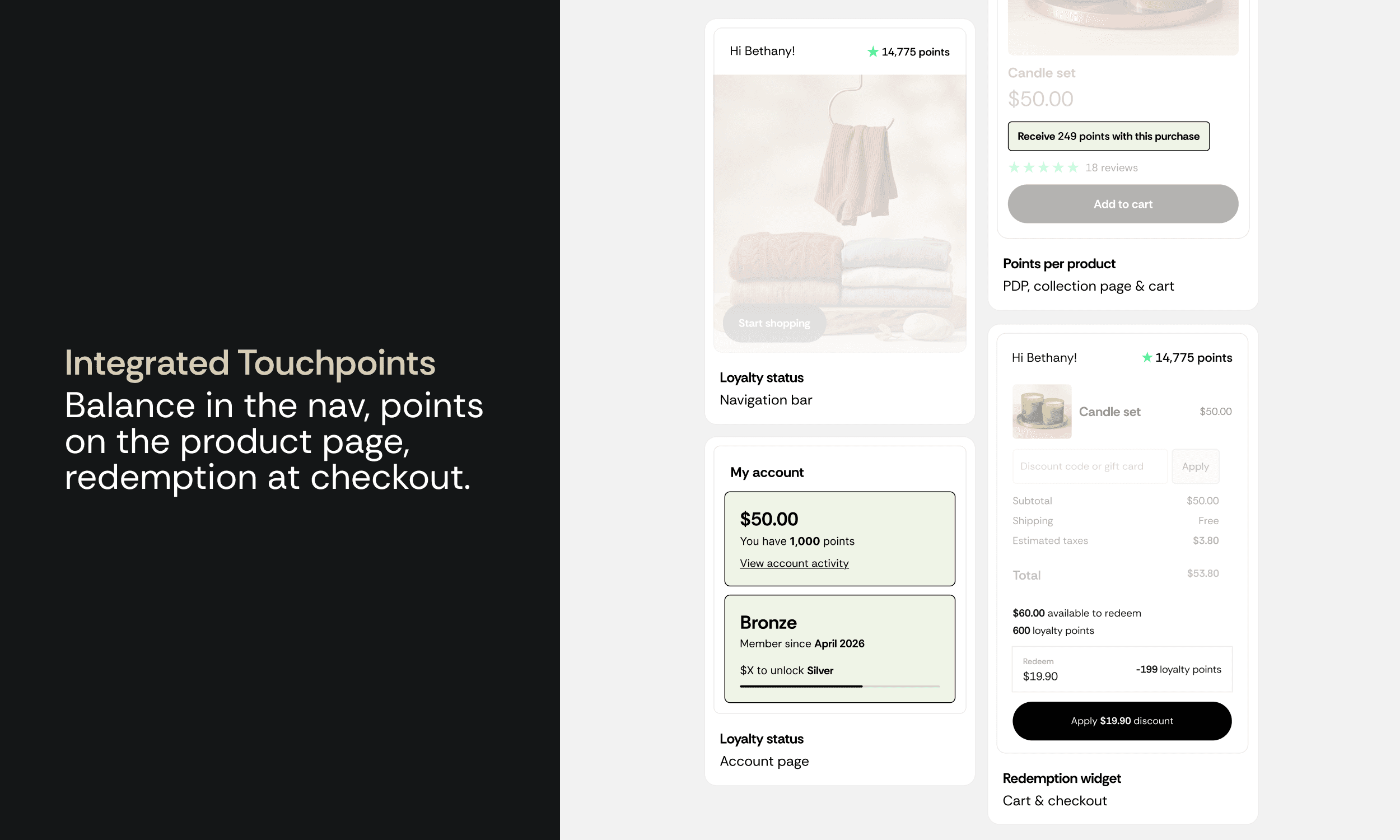
Place the system at every point of intent:
Navigation bar: a persistent "Rewards" entry, not a footer link
Product pages: the points this item earns, shown at the current multiplier, next to the price
Cart: points earned on this order and the distance to the next reward
Checkout: one-tap enrollment and wallet pass issuance
Order confirmation: the balance they just earned and what it unlocks
Account page: tier progress, active challenges, and countdown to expiry
Snif, Brixton, MegaFood, Sparkle in Pink, and Melissa each surface loyalty on the product page rather than behind a login. A shopper who sees the points before adding to cart is doing different math than one who finds out at checkout.
Play 7. Wire loyalty into the whole subscription journey
Subscriptions are the most-pushed offer of the BFCM weekend and the least durable. Across our merchant base, 88% of customers who start a subscription during BFCM have churned by February. Not paused, cancelled.
The reason is structural. A shopper who subscribes on Black Friday is subscribing to a discount, not to a product. They take the introductory offer, receive one or two shipments at full price in January, and cancel the moment the renewal charge stops feeling like a deal. Your subscription platform records a healthy signup number in November and a collapsing active count ten weeks later.
Most brands attack this with better onboarding emails. That helps at the margin, and it misses where the relationship is won or lost: inside the subscription experience itself. Bubblehouse integrates directly with Skio, Recharge, Ordergroove, Loop, and Stay Ai at the two moments that decide whether a BFCM subscriber survives to spring.
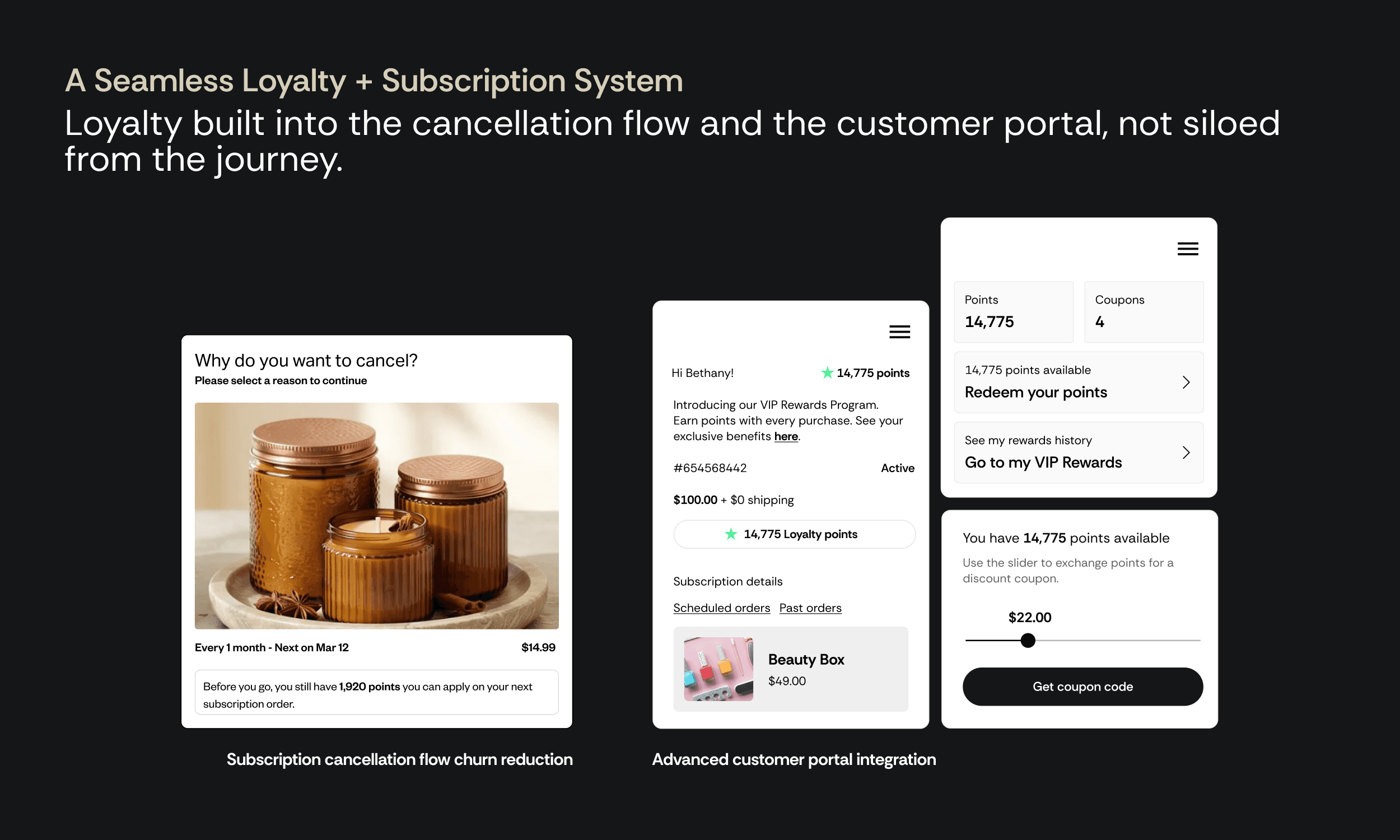
First, the customer portal. The portal is the one place a subscriber returns to every month, and most brands leave it loyalty-blind: no balance, no progress, no reason to stay beyond the product. Integrated, it becomes your retention surface:
The points balance sits on the subscription itself, and every renewal grows it
Subscribers slide points into a discount on their next scheduled order, choosing exactly how much to redeem
Tier status, rewards history, and redemption options live next to the order details, so the value of staying is visible on every visit
A subscriber who redeems points against the March order has a reason to still be subscribed in March. Every redemption borrows against a future shipment.
Second, the cancellation flow. When a customer clicks cancel, they weigh what staying costs against what leaving costs. If your loyalty system is invisible at that moment, leaving costs them nothing. Integrated, the cancel screen shows what walking away forfeits:
The points balance they have accrued, with the option to apply it to the next order instead of losing it
The tier they hold and the downgrade that follows
Progress on any active challenge or milestone
The reward already unlocked and waiting to be redeemed
Merchants running the cancellation-flow integration see subscription churn drop by up to 27%. Run that against the baseline: where 12 in 100 BFCM subscribers survive to March, integrated merchants keep roughly 36. Three times the cohort, from one integration.
Nothing about the offer changed. The customer saw the full price of leaving before they paid it.
The two surfaces compound. The portal builds the balance month after month, and the cancel screen is where that balance does its work. Subscribers enrolled in the loyalty system carry 2.2x the 12-month value of unenrolled subscribers in our base, because every shipment makes the next cancellation click harder.
Three notes on implementation, because the sequencing matters:
Connect the cancellation flow before BFCM, not in January when churn is already showing up in the dashboard. The subscribers you need to save sign up in November.
Give subscribers something to accumulate. A save screen showing a balance of 40 points saves nobody. Run a subscription milestone track so that by January the member has real progress on the line.
Pair the save screen with a downgrade path. Some subscribers want a lower frequency, not an exit. Keeping tier status intact through a frequency change retains more revenue than winning the argument at the cancel button.
CHAPTER 6
Measuring success: the 2026 metrics
Revenue on Black Friday tells you almost nothing about whether BFCM worked. Track these instead. Benchmark ranges below come from the Bubblehouse merchant base.
Enrollment rate. The percentage of BFCM buyers who left as identified members. The base-wide median runs 24%; top-quartile merchants clear 40%. Below 20%, your enrollment surface is broken.
Wallet pass adoption. Passes issued as a share of enrollments, and how many remain installed 30 days later. Top-quartile merchants issue passes to more than half of new enrollments and hold 80% installation at day 30.
60-day repeat purchase rate, members versus non-members. The core number. Members across the base repurchase at 2.4x the non-member rate. Run yours against the same window last year.
Member AOV versus non-member AOV. Segment by tier. If your top tier is not outspending the base by a meaningful margin, your tier benefits are not working.
Effective discount rate by segment. What you gave away per order, points liability included, split between members and non-members. This is the metric that shows whether loyalty protected margin or added to the giveaway.
Challenge completion rate. And the repurchase delta between completers and non-completers. The base averages 34% completion on seasonal tracks.
Reward redemption rate within 90 days. Healthy systems land between 60% and 70%. Unredeemed points are a liability, not a success.
Cross-channel member rate. The share of members transacting both in-store and online. These members carry the highest LTV in nearly every catalog we see, 2.6x single-channel members across the base.
BFCM subscriber survival to February. Take the cohort that subscribed during Cyber Week and measure the percentage still active on March 1. The category baseline is 12%. Merchants with the cancellation-flow integration live hold roughly 36%.
Cancellation-flow save rate. The share of subscribers who reach the cancel screen and stay. Segment it by whether the member had a visible points balance or tier at that moment, which tells you whether the save screen or the accrual needs work.
Schedule a call today to learn how Bubblehouse can transform your retention strategy into a scalable and impactful loyalty system.